
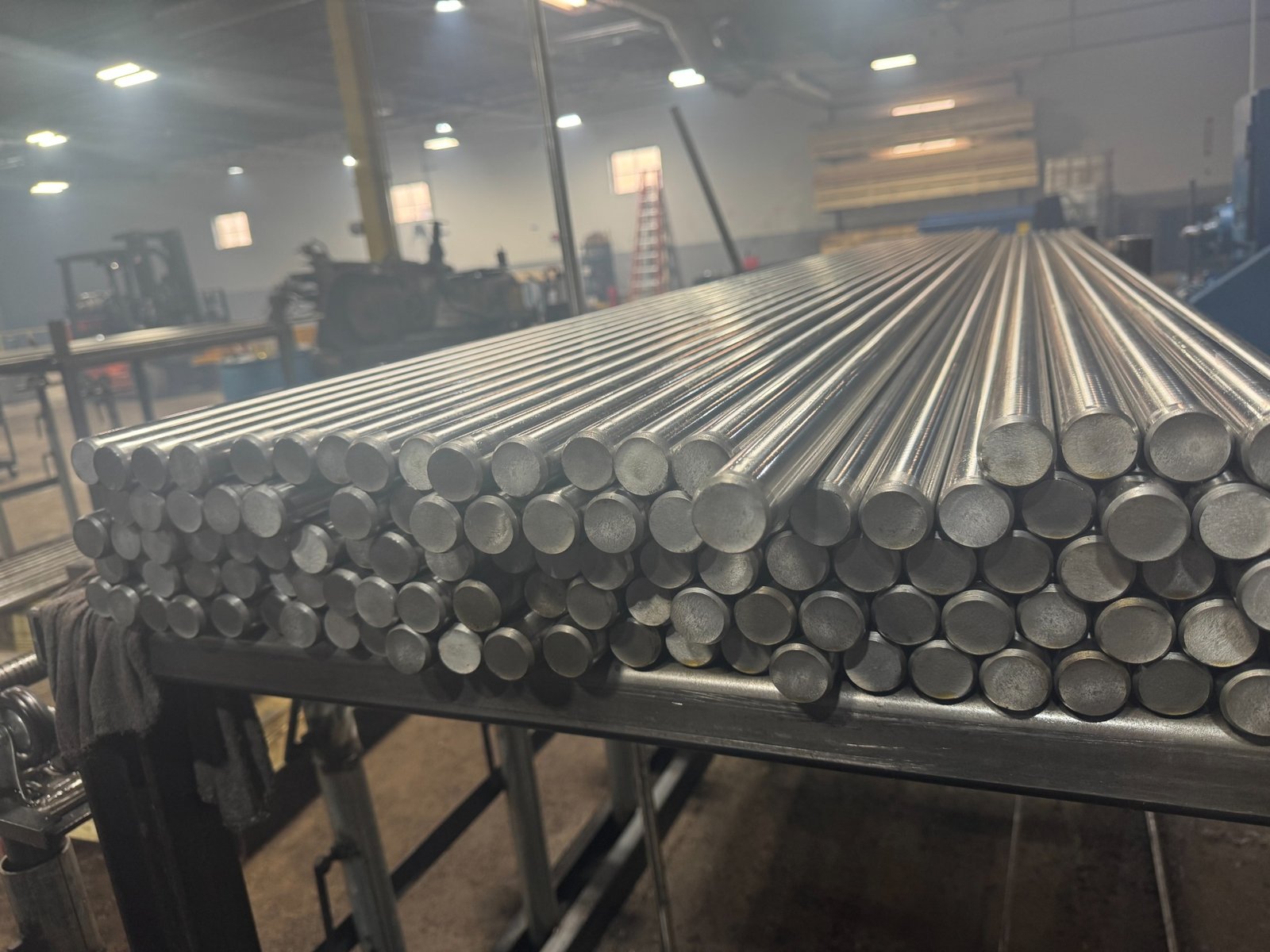


Ordering 17-4 PH H1025 stainless steel round bar? The heat-treatment condition is only part of the purchase requirement. A machine shop buying precision ground H1025 feedstock also needs to specify the final OD range, finished length, bar straightness, traceability and whether the bar will be machined after delivery. This guide focuses on getting a comparable 17-4 H1025 bar quotation, not on replacing the drawing or material standard.
Have a current requirement? Request pricing for precision ground rods. For base-alloy information, see the 17-4 PH material page.
What H1025 means—and what it doesn’t specify
17-4 PH stainless steel is also identified as UNS S17400 (Type 630). The H1025 designation identifies a precipitation-aging treatment. ATI’s alloy data sheet lists the nominal H1025 aging treatment as 1025°F (552°C) for four hours, followed by the stated cooling practice. Confirm the governing product standard, the mill’s certification, and the purchasing requirement; a grade designation alone is not proof of a particular heat-treatment lot.
H1025 does not automatically define bar diameter tolerance, straightness, roundness, surface finish, cut length, heat-number traceability or as-delivered stock availability. Those requirements must be called out separately.
H1025 ground stock vs grinding Condition A before aging
A buyer can encounter two distinct manufacturing routes: obtaining bar already aged to H1025 before final OD grinding, or purchasing material in Condition A for subsequent machining, aging or finishing. They are not interchangeable workflows. If a component will be heated after grinding, its size and straightness after the heat treatment may change, requiring allowance or finishing afterward.
| Question to settle | Why it affects the RFQ |
|---|---|
| Must the delivered bar be certified H1025? | Defines the required material condition at shipment. |
| Is final OD measured before or after any later aging? | Prevents a pre-heat-treatment dimension being mistaken for final acceptance. |
| What hardness or mechanical-property documentation is required? | The named condition and actual acceptance evidence should agree with the order. |
| Will the bar be turned into a long shaft or Swiss-machined part? | Influences straightness, finish and length requirements. |
| Does the print require lot and heat traceability? | Drives labeling, certificate review and packaging. |
Write OD tolerance using two explicit limits
“Half-thousandth tolerance” is ambiguous unless the nominal, upper and lower limits are specified. For example, 0.6250 ±0.0005 inch describes a permitted diameter band from 0.6245 to 0.6255 inch, while 0.6250 +0.0000/−0.0005 inch allows 0.6245 to 0.6250 inch. These are different requirements, even though both mention five ten-thousandths.
These figures are examples of how to write a specification, not a guarantee that H1025 bars in those dimensions can be supplied. Final feasibility depends on length, quantity, starting stock, hardness, finish and inspection method. For a more detailed checklist, use the ground-bar tolerance RFQ guide.
Straightness and surface finish should be separate line items
A long H1025 bar can pass a diameter check yet fall outside a customer’s bar-feeder or shaft-straightness requirement. State the permitted indication and how it is measured—including bar length, support locations, inspection span, rotation and reporting method. Do not assume a tolerance stated as “TIR per foot” is automatically equivalent to a general straightness grade.
If a bearing or sealing surface must meet a roughness limit, specify the parameter (for example, Ra), maximum value and units. A “16 finish” note without parameters or units can prompt a re-quote. Review metal bar straightening and polishing services for the available process paths.
Sample 17-4 H1025 ground bar RFQ
Illustrative purchasing language: “Quote 17-4 PH stainless round bars, UNS S17400, delivered in certified H1025 condition under the drawing’s specified product standard. Final ground OD 0.6250 ±0.0005 inch; 144-inch nominal bar length with length tolerance per print; 250 bars. State achievable straightness and surface-finish limits, material certificate and heat-lot traceability, packing method, lead time and whether any final processing occurs after aging.”
Adjust the grade standard, finished OD, length and quantity to your actual drawing. For orders to aerospace, medical or other controlled specifications, provide the correct purchase-order revision and acceptance documents.
Buyer checklist before sending for quotation
- UNS S17400 / Type 630 and exact applicable material standard and revision.
- Confirmed H1025 as-delivered condition, with required certificates.
- Nominal final OD plus explicit minimum/maximum limits.
- Length, quantity, any end prep or cut-blank requirements.
- Required surface finish, roughness units, and geometric controls.
- Straightness measurement setup and acceptance value.
- Customer-supplied material or vendor-sourced material.
- Delivery, protection, heat identification and packaging instructions.
Common questions from buyers
Is H1025 the same as H900 or H1150?
No. These are different aging conditions for the same base alloy, and they produce different property combinations. Do not change the required condition without engineering approval.
Can 17-4 H1025 be centerless ground?
A feasibility review should consider the delivered hardness, starting OD, final reduction, required tolerance, bar length, and available process. Centerless grinding can be considered for an OD finishing requirement; confirmation is job-specific.
Do I need a mill certificate if I specify H1025?
If the order requires confirmation of chemistry, heat treatment, traceability or material properties, specify the expected certificates and tests. Typing H1025 into an RFQ does not establish the delivered material’s history.
What if my material is already purchased?
Identify the supply route as customer owned and provide the current condition and incoming dimensional range. Use the customer-supplied grinding checklist for additional information.
Technical reference: ATI 17-4 product data sheet (heat-treatment conditions). Governing specifications and project documentation control purchases.
Get a reviewed quote: Send H1025 grade, finished diameter, length, quantity and straightness requirements to Precision Ground Rods.