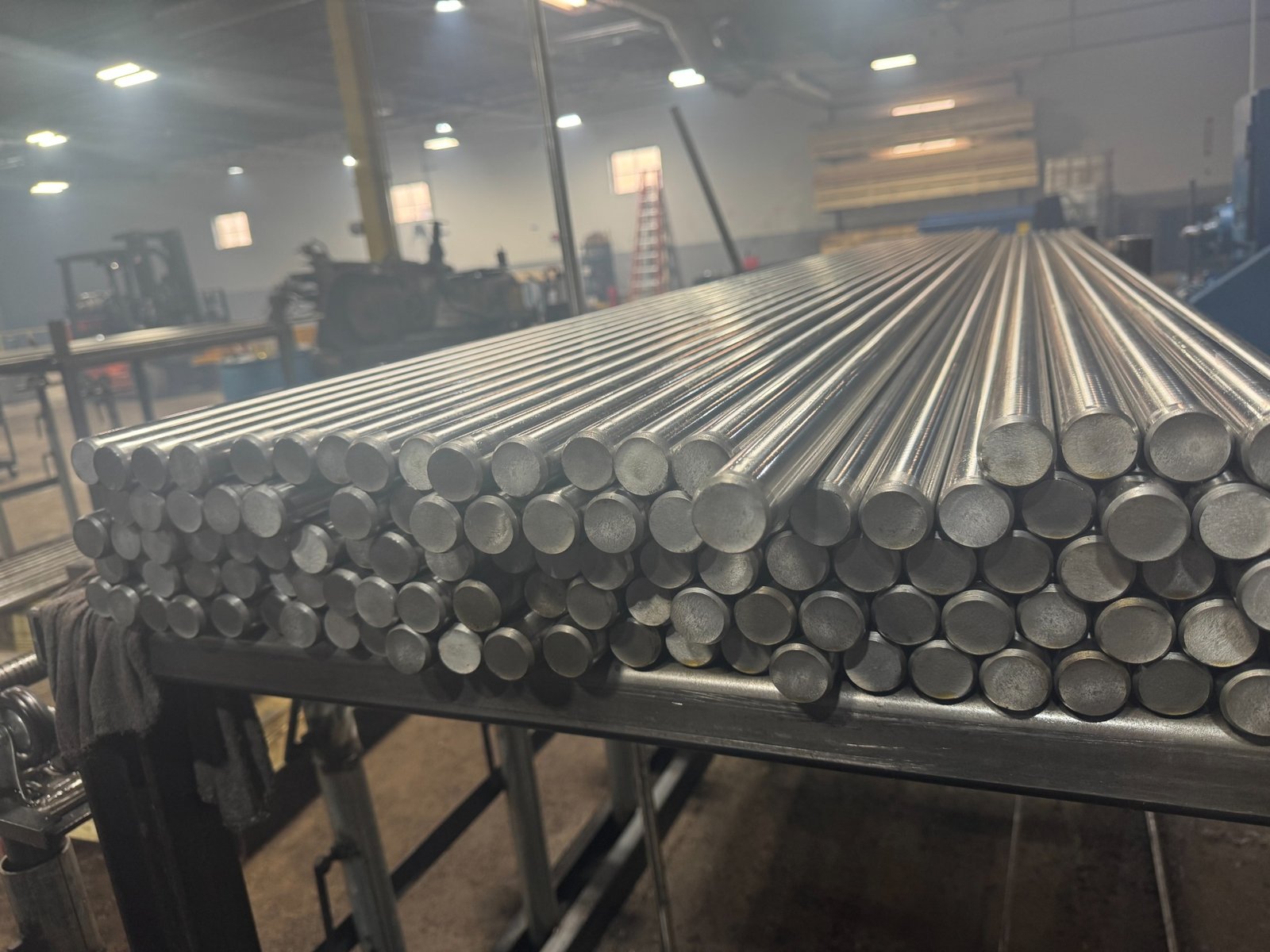


If you already own the steel or stainless bars, you’re not looking for a generic metal supplier: you need a processor to evaluate your incoming stock and produce a specified finished diameter, straightness and surface condition. The best customer-supplied bar centerless grinding RFQ starts with the material you actually have—not only the diameter you want.
Need your bar ground to size? Submit an RFQ to Precision Ground Rods and indicate clearly that the material is customer supplied. Our team reviews material and processing options for the specific request.
What the processor needs to quote a customer-owned job
| RFQ field | Why it matters | What to provide |
|---|---|---|
| Material grade and specification | Affects process feasibility, inspection and traceability | For example, 416 stainless to the actual governing standard and condition |
| Incoming OD and variation | Defines the starting stock and removal requirement | Measured OD range, not only nominal mill size |
| Target finished OD | Defines acceptance and feasible passes | Nominal plus explicit upper and lower limits |
| Length and quantity | Affects handling, support, setup and lot economics | Actual inches/feet or millimeters and number of bars |
| Current straightness | Bars with significant bow may require a separate operation | Observed bow/TIR, inspection span and test method |
| Final straightness and finish | Dimensions alone do not define delivered functionality | Separately stated straightness/roundness and Ra where needed |
| Material condition | Heat treatment and hardness affect process planning | Annealed, condition T, H900, Q&T, case-hardened, etc. as applicable |
| Receiving and return logistics | Determines handling cost and risk allocation | Packaging, lot labels, shipment plan, return destination |
Incoming size vs final size: why stock allowance matters
Consider a request to finish 0.750-inch incoming round stock at 0.742 inch. The nominal change is 0.008 inch on diameter, corresponding to 0.004 inch radially if the initial bar were perfectly round and concentric. But real incoming material has diameter variation, surface irregularity, bow, and hardness differences. The processor must review those conditions before estimating cuts, scrap risk or turnaround.
Never assume that a given diameter reduction can be completed in one grinding pass, that removal is identical on every bar, or that the starting OD equals the mill’s nominal size. Measurements across several incoming pieces are more useful than one number copied from the purchase order.
Why straightening may be needed before grinding
A long bar with significant bow can enter a grinding operation inconsistently. Depending on the condition and tolerance requirements, a separate bar straightening review may be needed before final OD work. The RFQ should disclose whether the bars arrive visibly crooked, have damaged ends, or show excessive movement in a support or feeder.
For a straightness complaint, describe how it was measured: end supports, separation between supports, measurement location, indicator position and total indicated movement. “0.006 inch per foot” is not by itself a complete universally accepted inspection setup. The processor should agree on the receiving and delivery test before work begins.
Grinding long bars vs short cut blanks
These are not necessarily the same production request. A 12-foot bar, 24-foot bar and six-inch pre-cut blank impose different handling and support constraints. Specify whether each bar must return at full length, may be cut after grinding, or is already cut before delivery.
For cut pieces, indicate whether ends must be square, chamfered or protected. For full-length pieces, include how rods will be bundled or boxed and what surface protection is needed to prevent transit damage. Review available value-added operations rather than assuming they are included in the grinding price.
Do not omit material hardness and traceability
The same alloy name can describe materially different grinding conditions depending on heat treatment and prior processing. For example, a precipitation-hardening stainless in an aged condition differs from the same alloy in its solution-treated condition. State actual hardness or heat-treatment condition when relevant, and keep material heat numbers separate.
If a material test report or heat-lot traceability is required, identify what you can supply with the incoming bars and what documentation you expect on return. Grinding is a sizing and finishing process; it should not be described as certifying an unknown material composition.
Example customer-owned grinding RFQ
Sample language: “We will supply 120 bars of 303 stainless, nominal 0.750 inch OD by 144 inches long. Actual incoming OD range and current straightness readings are available. Please evaluate centerless grinding to a final 0.7450 ±0.0005 inch, with straightness acceptance and surface finish to be agreed against our drawing. We require lot segregation, protective boxing and shipment back to our Illinois facility. Confirm feasibility, lead time and inspection scope.”
Numbers above are illustrative, not a general processing capability commitment. Replace them with the actual requirements and check the permitted OD, finish and straightness limits on the print.
What affects grinding lead time and price?
- Quantity and total weight, including how many different setups are required.
- Incoming-to-finished diameter change and current geometry.
- Alloy grade, condition and available processing information.
- Desired dimensional band, straightness and finish acceptance.
- Full-length versus pre-cut work and any secondary services.
- Packaging, transportation, traceability and inspection requirements.
An RFQ with complete incoming data is easier to assess than a request for a flat per-pound price without the stock condition. See the precision ground bar tolerance checklist if you need help defining the finished acceptance band.
Frequently asked questions
Will a processor grind customer-supplied material?
Many grinding providers evaluate customer-owned material, subject to grade, condition, geometry, capacity and commercial terms. Identify ownership and responsibility for incoming defects, inspection, yield and packaging in the quote.
Do I need to straighten every bar before grinding?
No. Straightening requirements depend on incoming bow and the finishing objective. The processor should review measurements and decide whether straightening is appropriate or necessary.
Can I send the bars before receiving a quote?
First confirm the process route, handling and receiving instructions with the supplier. Unplanned incoming shipments can complicate material identification and scheduling.
Can I request ±0.0001 inch OD on a long bar?
You can request any drawing-driven tolerance for review, but the supplier must confirm whether it is feasible for the specific material, diameter, length, surface condition, quantity and inspection plan.
Request a reviewed quote: Send your customer-supplied bar grinding requirements. Include available incoming measurements, the finished print, total quantity and expected delivery.