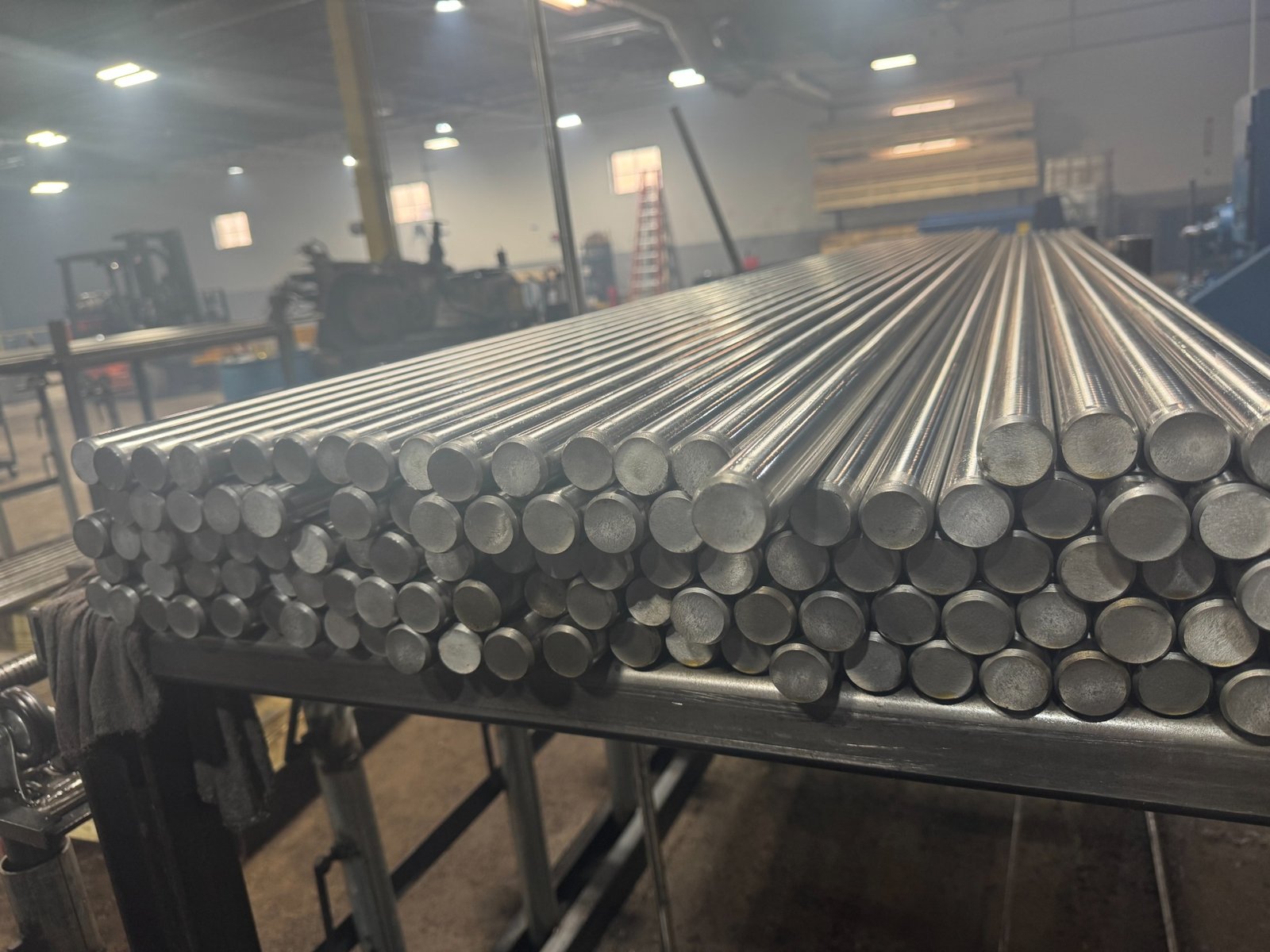


For screw-machine and CNC turning orders, the difference between 11L17, 12L14 and 1215 round bar is not only which steel cuts fastest. Lead content, case-hardening requirements, final part geometry and the condition of the delivered bar all affect what should appear on the purchase order.
This comparison focuses on purchasing precision ground feedstock, rather than repeating a general chemical-composition sheet. Need availability or special sizing reviewed? Request precision ground rod pricing.
Quick buying comparison
| Grade | Distinguishing feature | Common purchasing priority | What to confirm |
|---|---|---|---|
| 11L17 | Leaded, resulfurized steel with higher carbon content than typical 12L14 and 1215 supply | Machinable pins, studs and components where subsequent case hardening may be part of the approved design | Case-hardening process, mechanical condition, lead restrictions, OD and straightness |
| 12L14 | Leaded free-machining screw-machine steel | High-speed turning and efficient chip control when leaded steel is acceptable | Whether lead is permitted; approved material specification and downstream operations |
| 1215 | Free-machining low-carbon steel without a deliberate lead addition in the usual grade designation | Turning operations that need a nonleaded alternative to leaded screw stock | Required lead policy, mechanical properties, finishing, size and availability |
The grade name does not guarantee a particular delivered hardness, certificate package, machinability at your machine settings or final dimensional tolerance. Use the applicable drawing and material standard to define acceptance. Do not substitute among these grades on an existing controlled print without engineering approval.
When 11L17 is worth quoting
11L17 is often evaluated where machinability is important but the part design also calls for case hardening. It combines free-machining characteristics with a higher carbon level than some common screw-machine grades. This can matter for pins, studs and other machined components where the heat-treatment route has already been engineered.
For a precision bar RFQ, ask for 11L17 round bar in the specified condition and list the final OD band and straightness separately. If you will heat treat the finished part, identify that process before the supplier reviews processing and tolerances. Heat treatment can change final dimensions and straightness.
11L17 contains intentional lead. It is not a universal substitute for applications that prohibit lead or demand specific corrosion, welding or fatigue behavior.
When 12L14 may be the better machining choice
12L14 is widely used for automatic-screw-machine production because of its machinability and chip-breaking behavior. That does not mean it is the strongest or most appropriate grade for every component. In particular, welding requirements, restrictions on lead, and subsequent surface or heat treatment need review before selecting it.
If the goal is maximum machining throughput, compare trial-run cutting performance using actual material lots and tooling. Nominal machinability ratings are useful orientation, not a substitute for a production validation.
For buyers, the next decision is whether standard cold-finished stock is adequate or whether the machine needs ground OD consistency and defined straightness for bar feeding.
When 1215 makes more sense
1215 is a free-machining steel that can be considered when a nonleaded screw-stock grade is required. “Nonleaded” should not be confused with a universal chemical compliance certification: request the exact material chemistry and documentation needed by your customer’s specification.
For short-run turned parts, higher spindle speed is not always the deciding factor. Tooling changes, part rejection rate, bar feeding stability and finished-part requirements can be more important than a published comparative rating. Review 1215 precision round bar when your approved material callout permits it.
The ground-bar requirement can be more important than the machining grade
A machine running long bars benefits from a repeatable feedstock condition. Include:
- Actual finished OD band: for example, 0.6250 ±0.0005 in. defines an acceptable range of 0.6245–0.6255 in. It does not guarantee supplier feasibility for every grade and length.
- Length and bar form: 12-foot feed bars, shorter sticks, or cut-to-length blanks.
- Straightness: numeric limit, over what measured span, with what supports and acceptance method.
- Surface requirement: as-ground or polished; Ra value and units if needed.
- Material condition: cold finished, heat-treated or another approved condition; include material standard and certifications.
- Receiving concerns: scratches, dents, bent ends, corrosion, packaging or traceability requirements.
Do not call a bar “bearing quality,” “precision ground” or “Swiss-ready” and assume those terms establish identical tolerance and inspection commitments across suppliers. Specify what your equipment actually requires.
Example RFQ for a turning shop
Example only: “Quote 11L17 cold-finished precision ground round bar, final OD 0.6250 ±0.0005 inch, nominal 144-inch lengths, 400 pieces, with straightness and surface finish to be reviewed against our bar-feeder requirements. Include available material certification and estimated lead time.”
The wording is intentionally careful: it does not assign a tolerance to the supplier before feasibility review, and it flags straightness as a separately agreed requirement. A buyer with a print should provide the print’s actual limits rather than relying on an example.
Can I change from leaded steel to 1215?
Only when the engineering specification, required physical properties, machining and downstream processes permit substitution. 1215 should not be treated as a one-for-one replacement without checking chemistry, processing and component performance. For regulated or customer-controlled applications, document the approved material change.
How to compare supplier quotes correctly
Ask each supplier to quote the same grade and approved standard, nominal diameter, tolerance band, delivered length, finish, certification level, quantity and packaging method. Otherwise an inexpensive “round bar” quote can hide work your shop must complete before machining.
Useful outside technical references include the Metals Service Center Institute’s machinability rating discussion and published 11L17 material guidance. Ratings should be interpreted for the stated product condition rather than treated as universal shop speeds.
Frequently asked questions
Is 11L17 the same material as 1117?
No. The “L” identifies a leaded grade. Do not merge these purchase descriptions without specific engineering approval.
Which is better for a Swiss-type lathe?
It depends on the part’s approved material, actual cut cycle, bar-feeder configuration and final acceptance requirements. A fast-cutting grade will not solve a feedstock OD or straightness issue.
Do these grades come precision ground?
Availability and processing route depend on grade, diameter, quantity and mill supply. A ground finish and exact OD must be expressly included in the quote; they are not automatic properties of the base alloy name.
Ready to source? Send your grade, finished OD, quantity and machine requirements for a reviewed quotation. We can evaluate material sourcing and processing options rather than assume stock or guaranteed tolerance.